
Your Cart

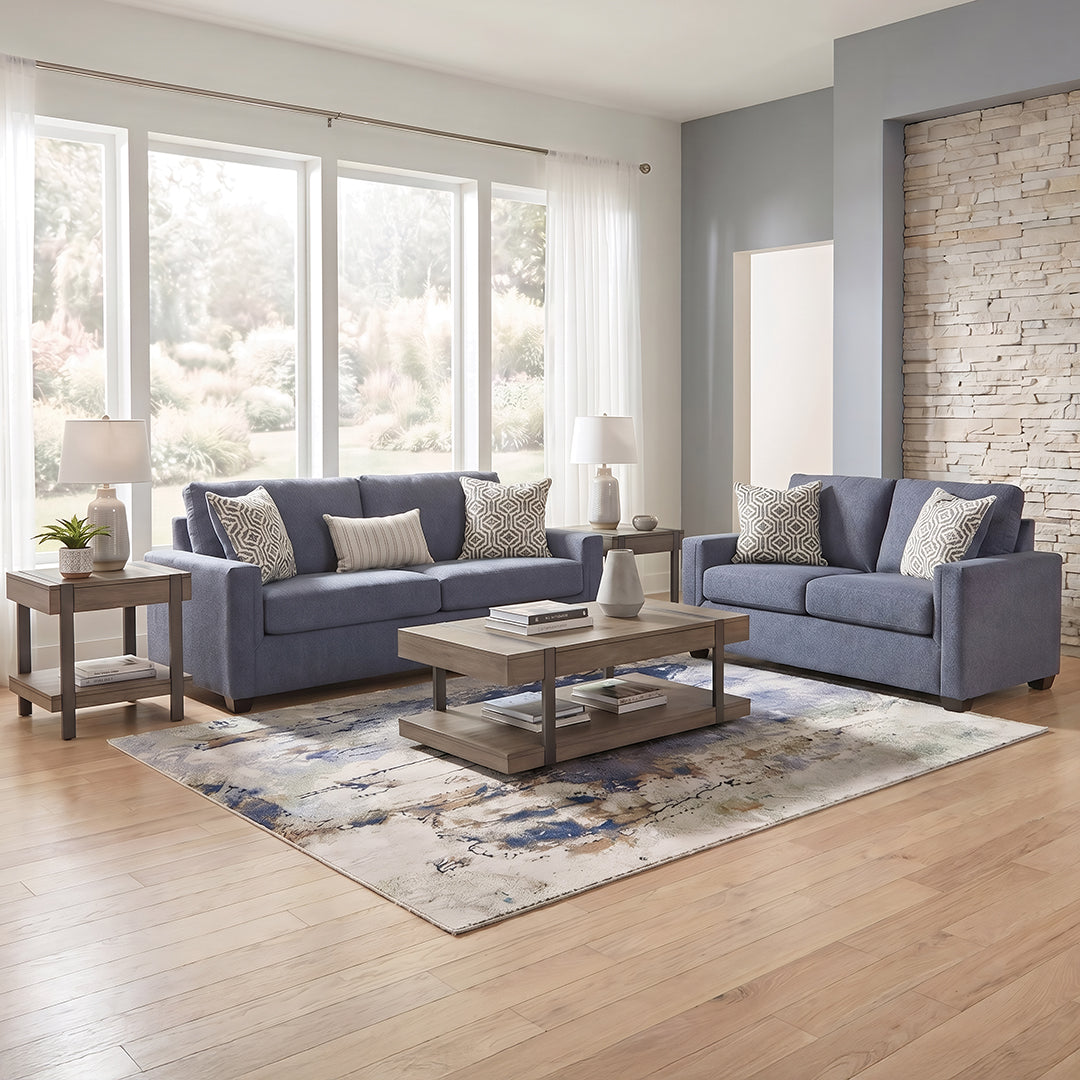
Living Room Buying Guide
Living Room Rug Placement & Size Guide: Formulas for Any Layout
Avoid the common "postage stamp" mistake with proven room clearance formulas, classic layout rules, and sectional sizing benchmarks.
At a Glance
Living Room Rug Sizing: Fast Decision Formulas
Need the quick answer before exploring the full clearance and configuration breakdown? Here is what works in most living rooms:
Standard 84" Sofa
8' x 10' Area Rug
Extends 18 inches past each sofa arm, framing your seating and leaving room for accent chairs.
View Sofa Formulas → Room Perimeter
12" to 18" Clearance
Target 18 inches of exposed floor in standard rooms (12 inches in compact spaces) to frame the layout.
View Clearance Math → Primary Seating
Front Legs on Rug
The most versatile rule: anchors the sofa and chairs to the central table without buying an oversized piece.
Explore Placement Rules → Sectionals & Chaises
9' x 12' or Layered
Sectionals over 100 inches require extended surface area so the chaise cushion return never floats off.
See Sectional Solutions →Why Is Buying the Right Rug Size So Hard?
Shopping for a living room rug should be straightforward. You find a color palette you love, picture how soft it will feel underfoot, and bring it home. But when you unroll it in front of your sofa, something feels off. The rug looks tiny. The coffee table barely perches in the center, the sofa sits entirely on bare flooring, and instead of pulling the room together, the rug looks lost in the middle of the floor.

As Ryan Storts, Store Manager and Room Planning Consultant at our Cold Spring showroom, often points out to customers, an undersized rug ends up looking like a postage stamp sitting in an airport hangar. This is the single most common mistake homeowners make: buying a rug that is one to two sizes too small for their seating group. An undersized rug disrupts visual proportions, cuts off sightlines, and makes a spacious living room feel disconnected and surprisingly smaller.
Showroom Reality: In our showrooms, we remind shoppers that a rug's primary visual job is to anchor your seating arrangement into a unified conversational zone. When furniture floats entirely beyond the rug perimeter, your eye reads the room as scattered individual pieces rather than a welcoming, cohesive space.
By the end of this guide, you will know how to calculate your exact wall clearance, choose the right rug dimensions for standard sofas and sectionals, avoid costly sizing returns, and protect your hardwood or luxury vinyl flooring.
How Far Should a Rug Be from the Wall?
Before you look at rug patterns or pile textures, you need to calculate the boundary between the rug perimeter and your room's outer walls. Leaving a border of bare flooring around your rug creates visual breathing room, highlights your flooring materials, and prevents the space from looking wall-to-wall carpeted.
The Standard Room Formula
1. The 18-Inch Perimeter Rule (Medium to Large Living Rooms)
For standard and spacious living rooms (roughly 13' x 16' or larger), our showroom team recommends aiming for 18 inches of exposed floor between the outer edges of the rug and the baseboards. This 1.5-foot margin provides an elegant border that frames your seating area while highlighting your hardwood or tile flooring.
The Math: If your living room measures 15 feet by 19 feet, subtract 36 inches (18 inches on each side) from both dimensions: 15' - 3' = 12' wide, and 19' - 3' = 16' long. A 9' x 12' or 10' x 14' area rug will fit the proportions of that room beautifully.
2. The 12-Inch Perimeter Rule (Snug Spaces & Urban Layouts)
If your room is compact (for example, 10' x 12' or 11' x 13'), an 18-inch border on all sides can shrink your rug boundary down to where it can no longer fit beneath your sofa's front legs. In smaller spaces, apartment living rooms, or narrower footprints, reduce the perimeter border to 12 inches of exposed floor.
The Clearance Distinction: Keep in mind that the perimeter formula calculates the maximum rug size a room can handle before crowding the baseboards. A 10' x 12' room with 12 inches of clearance can physically accommodate an 8' x 10' rug. Choosing a smaller 5' x 8' rug in that same room is an option for loveseats or reading nooks, but it is not the maximum size the room can fit.
Room Orientation and Sightlines
Always align the long edge of the rug with the long axis of your room or your primary seating arrangement. If your room is oriented horizontally toward a fireplace or entertainment center, your rug should run horizontally. Laying a rectangular rug perpendicular to the room's sightline visually cuts the floor plan in half and interrupts natural foot traffic.
Should Furniture Legs Go on the Rug?
Once you understand wall clearances, how should your furniture interact with the rug? In our showrooms, we guide customers through three proven placement methods. Which one works best depends on your room size, furniture scale, and whether your layout is open-concept or enclosed by walls.

Option 1
All Legs on the Rug
Every piece of seating furniture, including the sofa, accent chairs, side tables, and coffee table, sits completely inside the rug boundary. The rug extends at least 6 to 8 inches past all furniture edges.
Best For: Expansive rooms, open-concept floor plans, and floating furniture arrangements (typically requires a 9' x 12' or 10' x 14').
Option 2 (Most Versatile)
Front Legs on the Rug
The front legs of your sofa and accent chairs rest firmly on the rug (roughly 6 to 12 inches in), while the rear legs rest on bare floor. This connects all seating to the central coffee table without requiring an oversized rug.
Best For: Most standard living rooms, furniture resting against walls, and versatile layouts (typically utilizes an 8' x 10').
Option 3
All Legs Off the Rug
The sofa and chairs sit entirely outside the rug border, leaving only the coffee table resting on the rug. The rug serves strictly as a decorative centerpiece between your seating pieces.
Best For: Compact apartments, loveseats, or small reading nooks where an 8x10 rug would climb up the baseboards (typically uses a 5' x 8').
Showroom Warning for "All Legs Off": If you choose Option 3, make sure the rug is still at least as long as your sofa. If the rug is narrower than your sofa cushions, the arrangement will look pinched. Maintain 14 to 18 inches of walking space between the coffee table and sofa for comfortable legroom and easy reach.
What Size Rug Goes Under a Sofa or Sectional?
Your seating dimensions are the primary benchmark for selecting rug width and length. Let us examine how standard furniture configurations pair with common area rug sizes.

1. Standard 3-Cushion Sofas (78" to 90" Long)
A standard 84-inch sofa pairs naturally with an 8' x 10' area rug. Because an 8x10 rug is 120 inches long on its longest side, you receive 18 inches of rug extending past each sofa arm. This extra width creates a balanced visual frame and leaves room for the front legs of one or two accent chairs on either side. Browse our full selection of living room sofas to compare standard widths and profiles.
Why 5x8 Is Often Too Small: A 5' x 8' rug is only 96 inches long. Placed under an 84-inch sofa, you have only 6 inches of rug on either side. Once you place a coffee table in the center, the rug barely reaches the sofa's front edge, creating the awkward floating look that our design team cautions against.
2. Sectionals (L-Shapes, Chaises & U-Shapes)
Sectional seating requires special attention because you must accommodate both the primary sofa length and the extending chaise or return. When evaluating sectional size, the dimensions refer to the longest side or main run of the sectional. As a general rule, the rug should extend 6 to 8 inches past both the front and sides of the sectional's outer footprint.
- Compact L-Shape or Chaise Sectionals (longest side under 95"): An 8' x 10' rug provides sufficient surface area to support the front legs of the main seating and the entire chaise cushion base.
- Standard 5-Piece or 6-Piece Sectionals (longest side 100" to 125"): A 9' x 12' area rug is the recommended dimension. It allows the front half of the sectional and any accompanying cocktail ottoman to sit comfortably within the boundaries.
- Expansive U-Shape Sectionals (longest side over 125"): Look for a 10' x 14' rug to ensure the open conversational center does not feel pinched by bare borders.
Deciding between seating layouts? Read our detailed comparison on sectional vs. sofa living room layouts, or explore our full collection of living room sectionals to compare dimensions and configurations.
3. Accent Chairs and Side Tables
Accent living room chairs should either sit fully on the rug or have both front legs firmly planted. Avoid setups where one chair has two legs on the rug while another sits completely off, which can cause furniture wobbling. End and side tables can rest on bare flooring next to the sofa as long as they are easily reachable from the seating surface.
What If Your Room Needs a 9x12 or Larger?
Our online rug catalog currently tops out at 8' x 10' (with select 7' x 9' options), and we do not currently list 9' x 12' or 10' x 14' rugs online. If your open-concept living room or large sectional mathematically calls for a 9' x 12', you have three practical options:
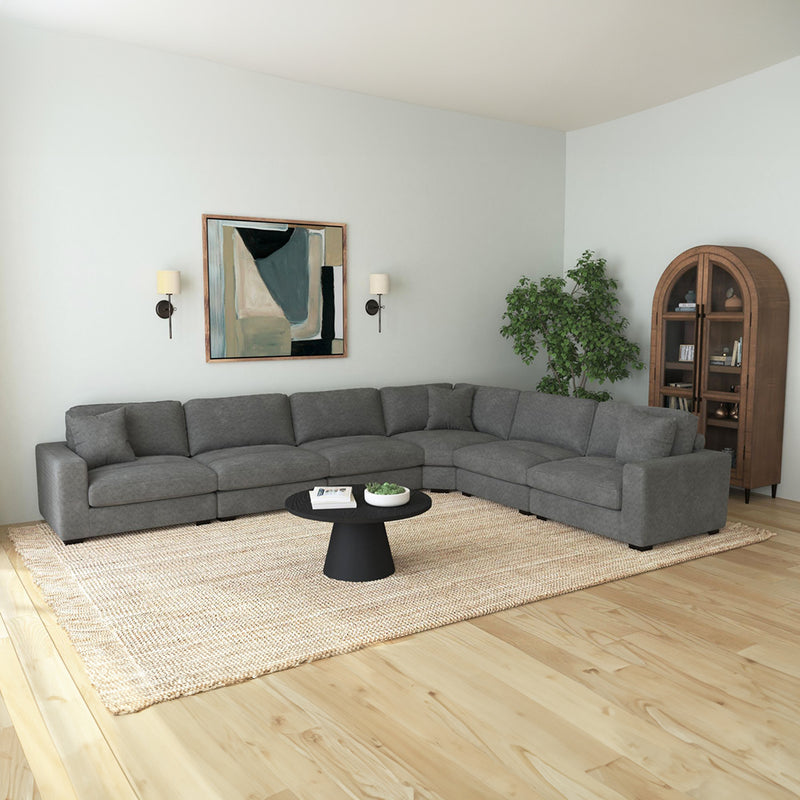
Design Technique
Option A: The Layered Rug Technique for Large Sectionals
Layer an 8' x 10' patterned or plush rug over a larger 9' x 12' or 10' x 14' neutral flatweave (such as natural jute or sisal). This delivers expansive floor coverage to ground your entire sectional layout while letting the 8x10 provide pattern, color, and softness right where your feet land.
Option B: Front-Legs-On Placement with an 8x10
If your sectional's longest side is up to about 100 inches, an 8' x 10' rug can still work effectively if you pull it forward. Place only the front 8 to 12 inches of the sectional and chaise on the rug, leaving the back legs on bare floor. This extends the rug farther into the center of the room to hold your coffee table and accent chairs. Beyond 100 inches, layering (Option A) is the better solution.
Option C: In-Store Showroom Orders
If your room calls for an oversized 9x12 or custom dimension, visit our showroom team to explore vendor catalogs and custom-order options available through our Furniture Fair showrooms.
How Much More Does a Bigger Rug Cost?
Budget is often the real reason homeowners settle for an undersized rug. In area rugs, doubling the physical surface area roughly doubles the price tag. An 8' x 10' rug covers 80 square feet, compared to just 40 square feet for a 5' x 8' rug. You are purchasing twice as much woven fiber, backing, and finishing material, which explains why stepping up in size shifts your investment.
Across our evergreen area rug collection, styles currently start around $150 and scale up to $1350 for artisan wool constructions. Quality dual-surface rug pads in our rug pad collection range from approximately $50 to $160 depending on pad thickness and dimensions.
How Rug Sizing Impacts Your Budget by Quality Tier
Rather than looking at individual rug patterns, it helps to understand how pricing scales across the three standard furniture quality tiers (Good, Better, and Best):
- Good Tier (Everyday Synthetics): Machine-woven polypropylene and polyester flatweaves. In a 5' x 8' size, these are the most budget-friendly options. Moving to an 8' x 10' in this tier typically adds modest cost while dramatically improving your room's spatial balance.
- Better Tier (Plush Blends & High Density): Heat-set yarns, carved textural patterns, and enhanced stain-shield weaves. Stepping up from a 5' x 8' to an 8' x 10' or 9' x 12' represents a moderate upgrade that delivers long-term durability for busy family living rooms.
- Best Tier (Natural Wools & Hand-Crafted Weaves): Hand-tufted, hand-loomed, or natural wool fibers with rich lanolin protection. Because these rugs require extensive hand craftsmanship per square foot, moving to an 8' x 10' or custom room rug represents a substantial investment that will anchor your home for decades.
Our Advice on Rug Budgets: A less expensive rug in the correct size will almost always look better in your living room than an expensive, premium rug that is too small. If an 8x10 wool rug exceeds your budget, choose an 8x10 synthetic or polypropylene rug rather than dropping down to a 5x8 wool. Getting the scale right does more for your room's aesthetic than fiber luxury in the wrong dimensions.
When Is a Smaller Rug the Right Call?
While most living rooms benefit from an 8' x 10' or larger rug, there are specific situations where a 5' x 8' or smaller accent rug is the smarter, more practical choice:
- Layering Over Neutral Broadloom: If you already have wall-to-wall neutral carpeting or an existing large flatweave, a 5' x 8' patterned rug works beautifully layered on top to define the coffee table zone.
- Independent Reading Nooks: If you have a dedicated accent chair and side table angled in a corner, an accent rug (3' x 5' or 4' x 6') establishes that corner as its own destination without interfering with the main seating area.
- Studio Apartments & Compact Living: When your sofa is under 72 inches wide or you are anchoring a loveseat, a 5' x 8' rug with coffee table placement keeps walking paths open and prevents baseboard crowding.
- Washable Rug Considerations: Keep in mind that our washable rugs currently come in 4' x 6' and 5' x 7' dimensions. They are ideal for high-spill zones, entryways, or casual coffee table perimeters, but they are not intended to anchor a full, multi-piece living room seating group. For tips on choosing the right construction, read our guide on how to find the perfect rug.
What Rug Size Fits Your Room?
Use this reference table to match your room dimensions and primary seating layout to the recommended rug size and placement approach.
| Rug Size | Best Room Dimensions | Seating Configuration | Recommended Rule | Layout Outcome |
|---|---|---|---|---|
| 5' x 8' | 10' x 11' or compact nook | Loveseat or compact apartment sofa (under 72") | All legs off / Coffee table only | Adds warmth in tight spaces without creeping up baseboards. |
| 6' x 9' | 11' x 13' to 12' x 14' | Mid-size sofa with one small accent chair | Front legs on (sofa only) | Balanced transition size for small-to-medium Midwest living rooms. |
| 8' x 10' | 12' x 15' to 13' x 17' | Standard sofa (84") plus two armchairs, or compact L-sectional | Front legs on all seating | The most versatile living room size. Anchors full conversation zones. |
| 9' x 12' | 14' x 18' to 16' x 20' | Standard sectional or sofa paired with loveseat | Front legs on sectional, all legs on coffee table | Spacious, luxurious feel that unifies larger family living spaces. |
| 10' x 14'+ | 16' x 22' or open concept | Large modular sectionals, multiple sofas, or expansive seating | All legs on rug | Defines the entire living zone inside an open-concept floor plan. |
What Do Showroom Designers Look for First?
Choosing a rug is about much more than colors and patterns. Ryan Storts, Store Manager and Room Planning Consultant at our Cold Spring, Kentucky showroom, shares his perspective on getting spatial proportions right from the very beginning.
"I tell customers all the time: do not fall in love with a rug pattern until you know your room dimensions. You can find the most gorgeous vintage motif or modern geometric pattern in the showroom, but if it is a 5x8 floating in an eighteen-foot living room, it looks like a postage stamp sitting in an airport hangar. Measure your seating footprint first, tape it out on the floor with blue painter's tape, and let the room dimensions dictate your rug size. Getting the scale right is what actually makes your room feel finished."

The Chaise Sectional Trap
Ryan notes that sectionals present a unique challenge that catches shoppers off guard:
"The biggest mistake I see with sectionals is people shopping for the sofa side and completely forgetting about the chaise. They buy an 8x10, tuck it under the main seats, and the chaise ends up floating two feet out onto bare hardwood floor. It looks unbalanced, and your heels land on cold floor every time you stretch out. If your sectional's longest side is over one hundred inches, you need a rug that spans the entire footprint, including the chaise return."
Watch: Room Planning Consultant Ryan Storts explains common rug sizes and how to choose the right fit for your living room.
What Rug Material and Rug Pad Do You Need?
Finding the right size is step one. Step two is choosing a fiber construction that matches your household's daily lifestyle, followed by the unsung hero of rug longevity: the rug pad.
Choosing the Right Rug Material
Wool Rugs: Natural Durability & Elegance
Wool is a premier natural fiber known for its resilience, natural fire resistance, and luxurious feel underfoot. Natural lanolin oils in wool fibers help repel surface dirt. Keep in mind that new wool rugs naturally shed loose fibers for the first few months, which is completely normal. Use gentle vacuuming without an aggressive beater bar to preserve the weave. Learn more in our guide on how to care for area rugs.
Polypropylene & Synthetic Fibers: The Family Workhorse
Polypropylene (also known as olefin) and polyester rugs are engineered for busy households. They resist stains, do not absorb spills readily, and shed very little. If you have kids, pets, or high foot traffic, synthetic area rugs offer outstanding durability and easy spot cleaning with water and mild detergent. For more tips on durable, pet-friendly living rooms, read our guide on how to buy pet-friendly furniture.
Washable Rugs: Everyday Convenience
Low-pile washable rugs can be cleaned directly in a home washing machine. Note that some washable rugs use a two-piece system with a separate non-slip backing, so check the product details before washing. Explore our machine washable rug collection for spill-prone spaces, casual family dens, or homes with active pets and kids.
Why a Quality Rug Pad Is Non-Negotiable
Many homeowners skip the rug pad at checkout, assuming it is an optional add-on. In reality, a quality dual-surface rug pad provides four critical benefits for your home:

Flooring Protection
Dual-Surface Rug Pads: The Unsung Hero of Hardwood Longevity
Rough jute or coarse latex rug backings can act like fine sandpaper against polyurethane hardwood finishes over time. A quality dual-surface felt-and-rubber pad prevents scratching, stops dangerous slipping, cushions daily foot impact, and significantly extends the life of your rug fibers.
- Prevents Dangerous Slipping & Creeping: Holds the rug firmly in place on slick hardwood, tile, or laminate flooring, keeping edges flat and safe for children and elderly family members.
- Protects Hardwood and Flooring Finishes: Many rug backings (especially rough jute or coarse latex) can act like fine sandpaper against polyurethane wood finishes over time. Choosing a pad from our rug pad collection prevents scratches and backing dye transfer.
- Extends Rug Lifespan: A dense pad acts as a shock absorber, cushioning the fibers every time someone steps on the rug and preventing fiber crush over years of daily traffic.
- Adds Luxurious Comfort: A 1/4-inch or 3/8-inch felt pad makes even an affordable flatweave or low-pile synthetic rug feel plush and comfortable underfoot. Learn all the details in our article on why you need a rug pad.
How Do You Measure Before You Buy?
Before you make a purchase, follow this 5-step checklist to confirm your room dimensions and ensure your rug fits properly on delivery day. For a complete walkthrough on taking room measurements, read our guide on how to measure your home for new furniture.

01
Room Footprint
Measure Baseboard to Baseboard
Record the exact length and width of your room from wall to wall. Note any architectural obstructions like floor heat vents, hearths, or doorways that cannot be covered.
02
Seating Zone
Measure Your Furniture Footprint
Measure the outer width of your sofa, the depth of your coffee table, and the position of accent chairs. For sectionals, measure both the main sofa run and the extending chaise depth.
03
Perimeter Clearance
Apply the 18" or 12" Clearance Rule
Subtract 36 inches (or 24 inches for compact layouts) from your room length and width. This calculation provides your maximum allowable rug size before crowding the outer baseboards.
04
Floor Mockup
Tape Out the Perimeter with Painter's Tape
Use blue painter's tape on your floor to outline the exact dimensions of an 8x10 or 9x12 rug. Walk around it to verify walkway clearances (maintain at least 30 to 36 inches for primary walking paths).
05
Door Clearance
Verify Door Swings & Thresholds
Measure the vertical gap under any nearby interior or closet doors. Ensure the combined pile height of your rug and rug pad will clear the bottom of the door without rubbing.
Frequently Asked Questions About Living Room Rugs
Here are answers to the most common questions our showroom design specialists hear from homeowners choosing living room area rugs:
What is the most popular living room rug size?
In most homes across Ohio, Kentucky, and Indiana, the 8' x 10' area rug is the most popular and versatile choice. It comfortably accommodates standard 84-inch sofas, anchors the front legs of surrounding accent chairs, and maintains the recommended 12 to 18 inches of exposed floor around the perimeter in typical 12' x 15' to 14' x 18' living rooms.
Should an area rug be centered in the room or centered on the furniture?
In almost all living room layouts, your rug should be centered on the furniture arrangement, not the room walls. Centering a rug in the room often leaves your sofa or sectional sitting awkwardly half-on and half-off, which disrupts conversational flow. The only exception is a completely symmetrical, formal living room where the seating group is already centered between opposing walls.
What size rug do you need for a sectional with a chaise?
If your sectional has an extending chaise lounge, you generally need a 9' x 12' area rug (or an 8' x 10' paired with the layered rug technique). The critical rule is that the rug must extend far enough beneath the chaise so the cushion return never floats on bare floor when you stretch out your legs.
Can an area rug be too big for a living room?
Yes. A rug is too large when it extends within 12 inches of your perimeter baseboards or crawls up against the walls. When an area rug touches the wall, it mimics wall-to-wall carpeting but lacks clean finished edges, which makes the room look crowded and visually shrunk.
Do I really need a rug pad if my furniture is heavy enough to hold the rug down?
Yes. While heavy furniture helps keep a rug stationary, a dual-surface rug pad provides crucial protection that furniture cannot: it prevents backing grit from scratching hardwood floor polyurethane, stops the rug foundation from stretching or wrinkling under foot traffic, and allows airflow to prevent trapped moisture underneath.
How much space should you leave between a coffee table and the sofa?
Maintain 14 to 18 inches of space between the front edge of your sofa and your coffee table. This leaves comfortable legroom to sit and stand easily while keeping drinks and remotes within convenient arm's reach from the sofa cushions.
So, What Size Rug Should You Buy?
To settle on the right rug size, start by measuring your seating footprint rather than just the room walls. Leave 12 to 18 inches of exposed floor around the perimeter, and treat placing the front legs on the rug as your most dependable default choice.
Keep the postage-stamp problem in mind as you browse. A rug that is too small makes the entire room feel smaller and disconnected, while the right proportion instantly unifies your living space.
Do not forget the rug pad. Adding a quality dual-surface pad is the most cost-effective step you can take to protect hardwood finishes from scratches, prevent dangerous slipping, and help your rug last longer. Read our guide on rug pad features and benefits before finalizing your order.
Need help planning your living room? Furniture Fair offers complimentary in-store design help with our room planning specialists across Ohio, Kentucky, and Indiana. For in-depth projects, our in-home design service requires a $150 deposit that applies directly toward your furniture purchase. Bring your room measurements and sofa dimensions to a Furniture Fair showroom near you, or tape out your layout on the floor first before deciding on a size.