
Your Cart

Quick Summary & Essential Rules
How to Choose the Right Mattress Firmness
The right mattress firmness depends on your sleep position and body weight:
- •Side sleepers: 4.5 to 5.5 (Medium-Soft to Medium)
- •Back sleepers: 6 to 7 (Medium-Firm)
- •Stomach sleepers: 7 to 8 (Firm)
- •Combination sleepers: 5 to 6 (Medium)
Under 130 lbs, go about one point softer; over 230 lbs, go about one point firmer with lower-gauge (thicker) or reinforced coils.
Firmness is not a sign of durability, price, or quality. It only describes how much you sink before you reach the support core.
Walk into three different mattress showrooms or browse three online brands, and you will quickly notice something frustrating: the word "Medium" means whatever the marketing team wants it to mean.
One manufacturer's Medium feels like a plush cloud. Another's Medium feels like a firm board with a thin layer of batting. When you buy a mattress based on a generic label rather than your body mechanics, you often wake up three weeks later with aching shoulder joints, numb fingertips, or persistent lower back stiffness.
Furniture Fair has been family-owned since 1963, every showroom has a dedicated Sleep Center with bedMATCH, and this guide draws on our mattress buyer Robbie Daniels to explain how firmness ratings work, what each sleep position requires, and how to match your body weight to the right support system.
Why Don't Firmness Labels Match Between Brands?
The single biggest trap in mattress shopping is assuming that firmness is standardized. Unlike shoe sizes or motor oil viscosity, there is no universal consumer firmness scale or regulatory testing standard for mattress firmness.
Each manufacturer creates their own internal scale. A brand that specializes in traditional innersprings might rate a bed as "Cushion Firm," while a direct-to-consumer foam brand might call an identical feel "Luxury Firm." To make things more confusing, terms like "Plush," "Pillow-top," and "Gentle Firm" describe surface construction rather than true spinal support.

The 30-Second Showroom Test Trap
Most shoppers test a mattress by sitting on the edge, pressing with a hand, or lying stiffly on their back for thirty seconds while wearing winter boots and a coat. That brief impression only tells you how the outermost top quilt feels under concentrated weight. It tells you nothing about whether your spine will stay aligned during seven hours of sleep in your natural sleep posture.
When you choose a mattress based on showroom marketing rather than your body type, two common problems occur:
- The bed is too soft: Your hips and pelvis, which carry a significant portion of your body weight, sink deeper than your shoulders and feet. Your spine bows downward in a hammock position, pulling lumbar muscles and creating morning stiffness across your lower back.
- The bed is too firm: Your shoulders and hips hit a rigid barrier that refuses to contour. Your body weight concentrates on those two small pressure points, pinching peripheral nerves, reducing blood circulation, and forcing you to toss and turn throughout the night.
What Do Mattress Firmness Ratings 1 to 10 Mean?
To bring clarity to the shopping process, sleep specialists use an informal 1 to 10 firmness scale. A rating of 1 represents zero resistance (like sleeping on a feather-filled duvet), while 10 represents sleeping on carpeted hardwood. In reality, virtually all residential mattresses fall between 2 and 9 on this 1 to 10 scale.
2–3
Soft / Plush
Deep sinking (2 to 3 inches). High contouring and pressure relief. Designed for lightweight side sleepers under 130 lbs.
4–5
Medium-Soft
Noticeable cushioning with 1.5 to 2 inches of give. Common choice for side sleepers under 130 lbs to 180 lbs.
5–6
Medium
Moderate contouring with balanced pushback. Accommodates combination sleepers and partners with different preferences.
6–7
Medium-Firm
Mild contouring with under 1 inch of sinkage and firm pushback. Preferred by back sleepers and heavier side sleepers.
7–8
Firm
Minimal surface give. Keeps hips elevated on top of the sleep plane for stomach sleepers and heavier back sleepers.
Firmness Scale Comparison
Use this breakdown to understand how sinkage depth, comfort materials, and support systems correspond across each firmness bracket, using standard weight brackets:
| Firmness Level | Rating (1–10) | Surface Feel & Sinkage | Primary Sleep Positions | Best Body Weight Match | Common Construction |
|---|---|---|---|---|---|
| Plush / Soft | 2 to 3 | Deep hug; 2 to 3 inches of sinkage; contouring envelope | Strict side sleepers | Under 130 lbs | Thick pillow-top, low-density memory foam |
| Medium-Soft | 4 to 5 | Cushioned contouring; 1.5 to 2 inches of sinkage | Side sleepers, back sleepers wanting cushion | Under 130 lbs, and 130 to 230 lbs side sleepers | Gel memory foam, plush Euro-top hybrid |
| Medium | 5 to 6 | Balanced blend; 1 to 1.5 inches of give; easy movement | Combination sleepers, side & back couples | 130 to 230 lbs | Pocketed coils with adaptive foam transition |
| Medium-Firm | 6 to 7 | Gentle give; under 1 inch of sinkage; strong pushback | Back sleepers, combination sleepers | 130 to 230 lbs, and Over 230 lbs side sleepers | Zoned pocketed coils, high-resilience foam |
| Firm | 7 to 8 | Rigid surface; minimal give; sleeper rests on top | Stomach sleepers, heavier back sleepers | 130 to 230 lbs stomach sleepers, Over 230 lbs back sleepers | Low-gauge coils, high-density base polyfoam |
| Extra Firm | 8 to 9 | Very rigid; virtually zero sinkage; flat plane feel | Specific orthopedic needs, strict stomach sleepers | Over 230 lbs | Dense innerspring with minimal quilt padding |
What Firmness Does Each Sleep Position Need?
Your body spends hours resting in one or two primary orientations. In an objective accelerometer study of adult sleep patterns, Skarpsno et al. (Nature and Science of Sleep, 2017) observed that adults spend approximately 54% of sleep time on their side, 38% on their back, and 7% on their stomach. Each posture creates distinct pressure zones that require specific counter-forces from your mattress comfort and support layers.

Side sleepers need enough surface cushion to allow the shoulder and hip to sink into the mattress, keeping the spine level.
The Biomechanics of Rest
When you stand upright with healthy posture, your spine naturally forms an elongated "S" curve. Your cervical spine curves slightly inward, your thoracic spine curves outward, and your lumbar spine curves inward toward your navel.
The primary objective of a mattress is to replicate that identical neutral alignment horizontally while you sleep. If a bed is either too rigid or too soft for your specific posture, your back muscles must contract all night long just to stabilize your vertebrae, leaving you fatigued in the morning.
Most Common Posture (~54% of Sleep Time, Skarpsno et al.)
The Side Sleeper
Recommended Firmness: 3 to 7 depending on weight (4.5 to 5.5 for average weight)
When sleeping on your side, your body weight rests on two narrow contact areas: your shoulder joint and your hip bone. If the mattress does not yield beneath those points, your shoulders bunch up toward your neck, and your pelvis tilts upward, causing spinal rotation.
- Key Need: Deep pressure relief to prevent pins, needles, and shoulder joint pinching.
- Ideal Materials: Memory foam, natural latex, or plush pillow-tops over pocketed coils that compress independently under wide curves.
- Pillow Pairing: Medium-to-high loft pillow to fill the wide gap between the ear and outside shoulder.
Second Most Common Posture (~38% of Sleep Time, Skarpsno et al.)
The Back Sleeper
Recommended Firmness: 4.5 to 8 depending on weight (6 to 7 for average weight)
Back sleeping distributes weight more evenly than other postures, but it introduces a critical challenge: the lumbar arch. Without adequate support, gravity pulls the lower back downward into an unnatural flat plane.
- Key Need: Lumbar contouring that fills the inward lower back curve without letting the heavier sacrum sag.
- Ideal Materials: Hybrid mattresses with zoned lumbar reinforcement or dense transition foams.
- Pillow Pairing: Medium-to-low loft pillow that supports the neck curve without tilting the chin forward toward the chest.
Least Common Posture (~7% of Sleep Time, Skarpsno et al.)
The Stomach Sleeper
Recommended Firmness: 6 to 8.5 depending on weight (7 to 8 for average weight)
Stomach sleeping places substantial mechanical stress on the neck and spine. Because your pelvis is dense and heavy, soft comfort layers allow the hips to sink deep into the bed while the upper torso stays elevated, forcing the lower back into an uncomfortable reverse arch.
- Key Need: Flat surface stability that keeps the pelvis on the exact same plane as the chest.
- Ideal Materials: Traditional firm innersprings, tight-top hybrids, or high-density firm foam with minimal surface give.
- Pillow Pairing: Extremely flat, thin pillow (or no pillow at all) to prevent hyperextending the cervical vertebrae.
Dynamic Sleepers (Shift Postures Nightly)
The Combination Sleeper
Recommended Firmness: 4 to 7.5 depending on weight (5 to 6 for average weight)
If you fall asleep on your back, wake up on your side, and roll over several times throughout the night, you require a responsive bed that adapts rapidly to changing body angles without trapping you in a deep memory foam "crater."
- Key Need: Fast surface recovery and ease of movement so repositioning does not disrupt sleep.
- Ideal Materials: Hybrid mattresses with individually wrapped pocketed coils and buoyant latex or responsive gel foams.
- Pillow Pairing: Adaptable memory foam cluster or shredded latex pillow that reshapes easily when turning.
How Does Body Weight Change How Firm a Mattress Feels?
When a mattress manufacturer tests a bed for firmness, most firmness ratings assume an average-size adult. If your body weight falls significantly below or above that baseline, your physical experience of that mattress will vary substantially from the number on the spec sheet.
Under 130 lbs
Feels +1 Firmer
Lighter sleepers apply less downward pressure. Dense comfort foams remain uncompressed, so a "Medium" feels like a "Medium-Firm." Aim for softer models (3 to 5) with plush micro-quilted tops.
130 to 230 lbs
True to Rating
The industry standard testing zone. Mattresses perform as labeled. Choose firmness primarily based on your sleeping posture and personal comfort preferences.
Over 230 lbs
Feels +1 Softer
Heavier weight compresses comfort layers completely ("bottoming out"). A "Medium" will feel soft and unsupportive. Choose firmer builds (6.5 to 8) with lower-gauge (thicker) or reinforced coils.

Recommended Firmness by Sleep Position & Body Weight
Cross-reference your sleep style and body weight in this table to pinpoint your target firmness score:
| Sleep Position | Under 130 lbs (Lightweight) | 130 to 230 lbs (Average Weight) | Over 230 lbs (Heavier Weight) |
|---|---|---|---|
| Side Sleeper | 3 to 4 (Soft / Plush) | 4.5 to 5.5 (Medium-Soft to Medium) | 6 to 7 (Medium-Firm Hybrid with Reinforced Edge) |
| Back Sleeper | 4.5 to 5.5 (Medium) | 6 to 7 (Medium-Firm) | 7 to 8 (Firm with Heavy Coil Gauge) |
| Stomach Sleeper | 6 to 6.5 (Medium-Firm) | 7 to 8 (Firm) | 8 to 8.5 (Extra Firm Heavy-Duty) |
| Combination Sleeper | 4 to 5 (Medium-Soft Responsive) | 5 to 6 (Medium Hybrid) | 6.5 to 7.5 (Medium-Firm Hybrid with Latex or Fast Foam) |
Is Mattress Firmness the Same as Support?
Perhaps the most common misconception in sleep retail is equating firmness with support. Many people assume that a hard bed is inherently supportive, and a plush bed is inherently unsupportive. In modern mattress engineering, that could not be further from the truth.
A mattress is constructed in two distinct mechanical sections: the comfort system on top (quilting, pillow-top layers, memory foam, or latex) and the support core beneath (individually wrapped coils, dense polyurethane foam, or zoned spring arrays).
Here is what actually trips people up on the showroom floor: they confuse surface cushion firmness with deep core support. You can have a pillow-top mattress that feels like sleeping on a cloud for the first ten minutes, but underneath those plush comfort layers, you have high-gauge pocketed coils keeping your spine completely straight. Or you can lie on a rock-hard traditional bed that actually sags two inches under your lower back because the coil unit has no zoned reinforcement. Support is whether your spine stays in neutral alignment; firmness is simply how much cushion your hips and shoulders sink into before they reach that support. Get the support right for your body weight first, then dial in the surface firmness for your sleep position.


A cutaway view showing the top comfort layers (engineered for pressure relief) resting over the support core (engineered for spinal alignment).
How the Two Layers Work Together
When you evaluate a mattress, think of it as a two-stage system:
- The Comfort Layers (Top 2–4 inches): Responsible for pressure relief, contouring, surface temperature regulation, and initial softness. This layer accommodates your sleep posture.
- The Support Core (Bottom 6–9 inches): Responsible for keeping your spine horizontally aligned, preventing your hips from sagging, supporting heavy body zones, and ensuring the mattress lasts for years without premature body impressions.
This is why hybrid and foam mattresses can offer cushioned surface comfort while still providing stable spinal support beneath.
How Does bedMATCH Help You Choose?
Understanding sleep mechanics and firmness numbers is helpful, but testing a bed in a showroom can still leave you second-guessing. That is why Furniture Fair invested in the patented bedMATCH diagnostic system across our Sleep Centers in Ohio, Kentucky, and Indiana.

The bedMATCH diagnostic test measures your pressure points in your preferred sleep position to identify matching mattresses on the floor.
How the bedMATCH Test Works
The bedMATCH system uses 18 statistical measurements and over 1,000 scientific calculations to identify your postural support needs:
- Enter Your Sleep Profile: You answer a few questions about your sleep position, temperature preferences, and whether you experience morning aches.
- Lie Down on the Test Bed: You lie on the diagnostic mattress in your natural sleep posture while the system maps where your body applies pressure.
- Color-Coded Recommendations: The system calculates your postural support level and identifies every matching mattress on our showroom floor color-coded to your results.
What If Firmness Isn't Actually Your Problem?
Before you shop for a different firmness, rule out these common causes:
01 Mattress Lifespan
A Sagging Mattress Past 7 to 10 Years
When a mattress reaches seven to ten years of age, the comfort foams break down and the spring unit loses its pushback. If your bed sags in the center, buying a firmer mattress topper or trying to rotate an expired mattress will not help. The bed needs replacing, not a firmer label.
02 Pillow Geometry
A Pillow Height & Density Mismatch
If your pillow is too high or too flat for your sleep position, your neck is bent at an awkward angle all night. That cervical strain radiates directly into your upper back and shoulder blades, creating discomfort that feels like a mattress problem even when your bed is performing properly.
03 Thermal Regulation
Sleeping Hot & Trapping Body Heat
If you wake up sweating or kicking off the covers, that is a thermal regulation and materials issue, not a firmness problem. Dense memory foams without phase-change materials or ventilated cell structures trap heat whether they are rated plush or extra firm. Read our hot sleeper solutions guide to learn about breathable cooling fabrics and phase-change mattress covers.
04 Comfort Baseline
You Already Love Your Current Bed's Feel
If you currently sleep comfortably and wake up pain-free, do not feel pressured to switch to a different firmness because of an article or chart. Start by matching your current bed's construction and firmness level rather than reinventing what is already working for your body.
5 Costly Mattress Firmness Mistakes to Avoid
Over decades of helping customers select mattresses, our showroom specialists have identified five recurring mistakes that lead to buyer regret and uncomfortable sleep:

01 Orthopedic Evidence
Assuming a Firmer Mattress Will Cure Lower Back Pain
For decades, traditional advice was to buy the hardest bed possible for back pain. However, medical research consistently shows that extra-firm mattresses can worsen back discomfort by failing to support the lumbar curve.
In a randomized, double-blind trial published in The Lancet, Kovacs et al. (The Lancet, 2003) demonstrated that patients with chronic non-specific low back pain who slept on medium-firm mattresses reported significantly better pain relief and functional improvement than those on firm mattresses. A systematic review by Radwan et al. (Sleep Health, 2015) similarly concluded that medium-firm mattresses promote better subjective sleep quality and spinal alignment while reducing pain.
A mattress is not a medical treatment, and back pain that is chronic, severe, or accompanied by numbness should be evaluated by a medical doctor.
02 Break-In & Adjustment
Forgetting That New Mattresses Require a Break-In Period
Fresh out of the factory, brand new foams and coils are stiff. A new mattress will feel noticeably firmer out of the box than the showroom floor model, which has already been conditioned by daily testing. It takes time for new cellular foam layers to open up and adapt to your body weight.
Per Furniture Fair's Mattress Comfort Guarantee, a new mattress must stay in your home for at least 30 days so your body and the comfort materials have time to adjust. If you still need a different comfort level, the re-selection window varies by brand (such as 30 to 60 days for Serta Perfect Sleeper, 30 to 90 days for Tempur-Pedic), though select brands plus clearance and floor models are excluded. Comfort exchanges carry a disposal fee of 10% of the purchase price (capped at $250) plus a delivery fee.
03 Pillow Geometry
Overlooking Your Pillow's Height and Density
Your mattress and your pillow function as an interconnected system. If you buy a plush mattress that lets your shoulders sink two inches, but continue using a thick, rigid pillow, your neck will be forced upward into cervical misalignment. Always evaluate your pillow loft alongside your mattress firmness.
04 Ergonomic Mechanics
Not Factoring in an Adjustable Base
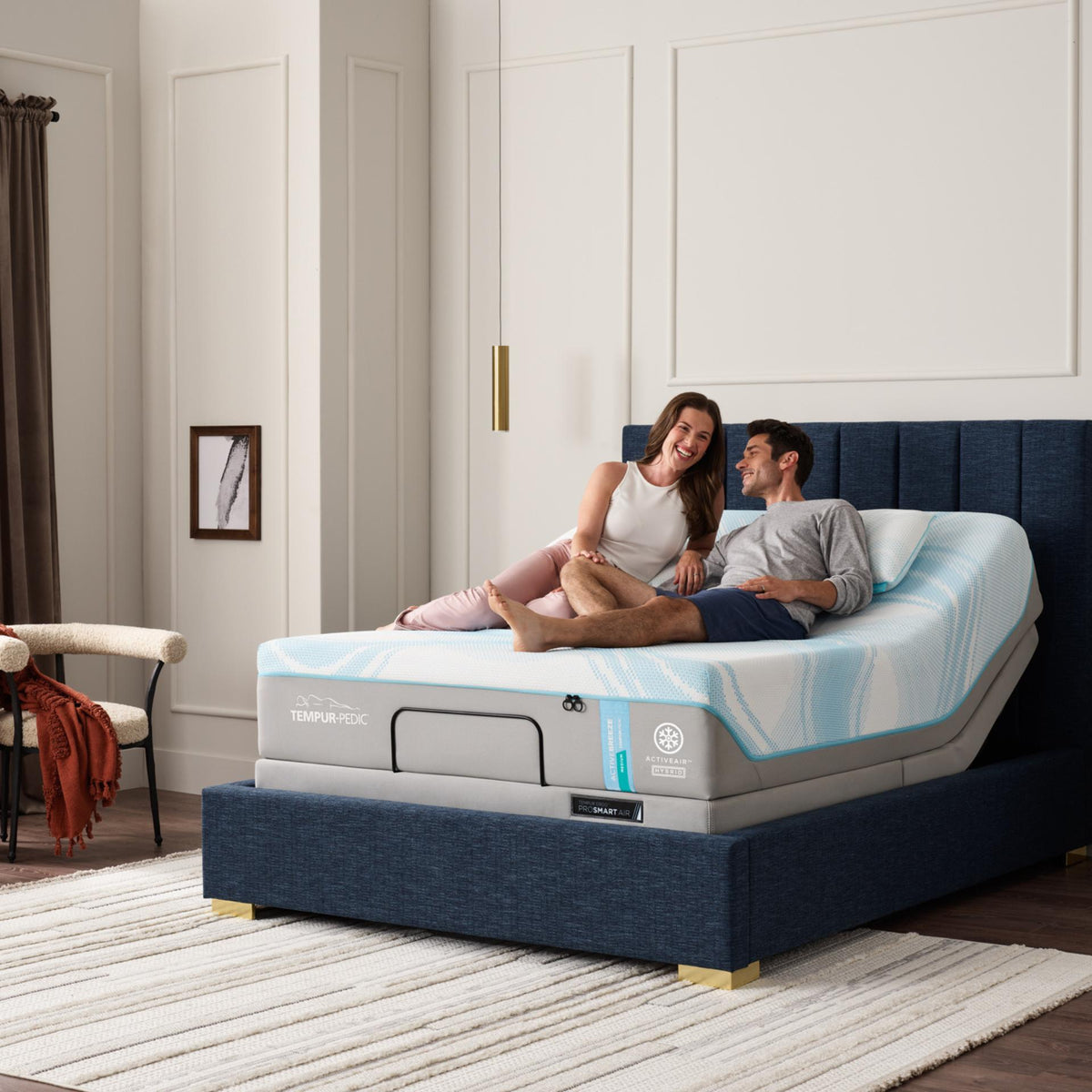
An adjustable power base can dramatically change how firm a mattress feels. Slightly elevating the head and knees into the zero-gravity position redistributes pressure across your entire back and removes compression from the lower lumbar discs. Back sleepers who find flat mattresses uncomfortable often discover that an adjustable base makes a medium-firm mattress feel supportive and pressure-free. Learn more in our guide to adjustable bases.
05 Structural Support
Trying to Fix a Sagging Mattress with a Foam Topper
If your existing mattress is seven to ten years old and sagging in the middle, adding a mattress topper will not restore firmness or support. A topper simply conforms to the underlying sag, leaving your spine misaligned. Toppers can soften a bed that is too firm, but they cannot restore lost structural support.
Frequently Asked Questions About Mattress Firmness
Here are straightforward, showroom-tested answers to the questions our Sleep Center teams hear every day from shoppers across Ohio, Kentucky, and Indiana:
What mattress firmness is best for chronic lower back pain?
For most people with non-specific lower back pain, a Medium-Firm mattress (rated 6 to 7 out of 10) provides the most reliable relief. In clinical trials by Kovacs et al. (The Lancet, 2003) and a systematic review by Radwan et al. (Sleep Health, 2015), medium-firm surfaces consistently outperformed firmer beds by cushioning the shoulders and hips while maintaining neutral lumbar curvature. A mattress is not a medical treatment, and back pain that is chronic or accompanied by numbness should be evaluated by a doctor.
Can a mattress topper fix a bed that is too firm or too soft?
A mattress topper can successfully soften a mattress that feels too rigid. Adding a 2 to 3 inch memory foam or latex topper provides immediate surface cushioning for hips and shoulders. However, a topper cannot fix a mattress that is too soft or sagging. If the underlying support core is worn out or too soft, the topper will simply contour into the dip, leaving your spine misaligned.
How long does it take for a new mattress to break in?
A brand new mattress typically requires 30 to 60 nights to break in. Factory-fresh foams and brand-new coils are stiffer than floor models that have been conditioned by customer testing. During the first few weeks, your body is also recalibrating to proper postural support, which can cause temporary muscle adjustment soreness.
What is the difference between innerspring, memory foam, and hybrid mattresses for firmness?
Firmness depends on layer density rather than mattress category, but the materials feel distinct: traditional innersprings offer buoyant, on-top pushback with fast bounce; memory foam provides deep contouring with slower response that hugs the body; and hybrids combine the contouring of foam with the responsive pushback of pocketed coils, making them the most versatile choice for varying body types.
Which mattress firmness should couples choose if they have different sleep positions?
Couples with differing sleep styles generally have two successful options: choose a Medium hybrid (rated 5 to 6) with pocketed coils to minimize motion transfer and provide compromise comfort, or invest in a Split King mattress setup. A Split King consists of two Twin XL mattresses placed side-by-side, allowing each partner to select their exact individual firmness level and pair it with an independent adjustable base.
How does an adjustable base change how firm a mattress feels?
An adjustable power base significantly alters perceived firmness by redistributing body weight. When you elevate your head and feet into the zero-gravity posture, gravitational pressure is lifted from your tailbone and lower back. This allows back sleepers to enjoy lumbar relief on a slightly firmer mattress that might otherwise feel rigid when lying completely flat.
Finding Your Ideal Sleep Surface
Choosing the right mattress firmness is not about guessing between marketing labels or buying the most expensive bed in the showroom. It is about understanding the biomechanics of your sleep position, accounting for your body weight, and ensuring your spine stays in neutral alignment from the moment your head hits the pillow until your alarm sounds in the morning.
If you are ready to test mattresses in person, visit any Furniture Fair Sleep Center. Lie down on our patented bedMATCH system, discover your color-coded support level, and compare every matching mattress on our showroom floor.

In-House Delivery & Removal
Delivered by Our Own Team, Never Outsourced
When buying a new mattress, getting rid of your old one is often the hardest part. Furniture Fair delivers with our own professional in-house team, and old mattress removal and haul-away is available for $199 through our partner Junk King. Learn more about our delivery and haul-away options.
To continue researching your sleep setup, explore our guides on mattress types and materials, compare the pros and cons of hybrid mattresses, review our mattress price guide, and read the full details of our Mattress Comfort Guarantee.